
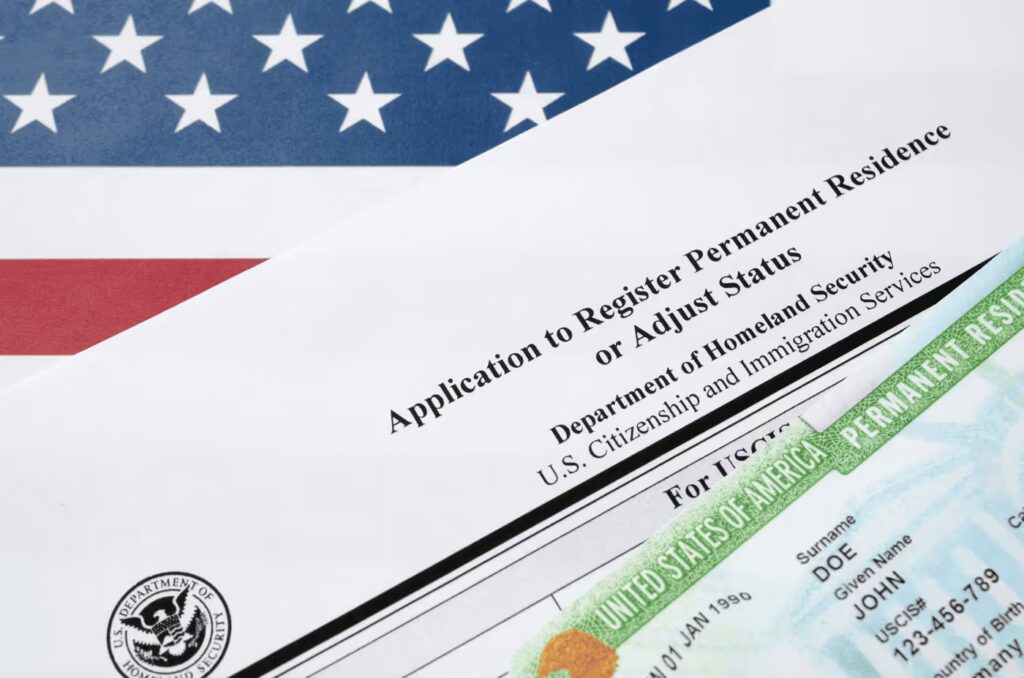
To be eligible for Adjustment of Status (AOS), an applicant must generally be physically present in the United States following inspection and admission or inspection and parole by an immigration officer, be the beneficiary of an approved immigrant petition, and have an immigrant visa immediately available. Certain limited exceptions may apply based on the applicant’s specific circumstances.
There are several different ways to obtain lawful permanent residence in the United Sattes. Choose on a category below to learn more about it.
Did you or a family member enter the United States legally and want to apply for a green card through a qualifying relative? If you have one of the following family relationships, you may be eligible to apply for permanent residence.
Spouse of a U.S. citizen
Unmarried child under 21 of a U.S. citizen
Parent of a U.S. citizen (if the U.S. citizen is at least 21 years old)
(Applicants in these categories must have a visa number available according to the Visa Bulletin)
Family members of a U.S. citizen:
Unmarried son or daughter (21 or older)
Married son or daughter (any age)
Brother or sister (if the U.S. citizen is at least 21 years old)
Family members of a lawful permanent resident:
Spouse
Unmarried child under 21
Unmarried son or daughter (21 or older)
Individual admitted to the United States as a K-1 fiancé(e)
Child admitted as a K-2 derivative
You were married to a U.S. citizen at the time of their death and meet eligibility requirements
You may be eligible to apply independently if you are:
An abused spouse of a U.S. citizen or lawful permanent resident
An abused child (unmarried and under 21) of a U.S. citizen or lawful permanent resident
An abused parent of a U.S. citizen
Because eligibility for Adjustment of Status depends on both your immigration history and your relationship to the petitioner, a detailed case review is essential before filing.
Important Notice
These resources are provided for general informational purposes only and are not a substitute for legal advice. Every immigration case is different.
Complete our Immigration Intake form or call our office at 757-422-8472 to schedule a consultation and learn more.
U.S. immigration law allows certain individuals to obtain lawful permanent residence (a green card) through employment in the United States.
Employment-based green cards are divided into preference categories. Each category has specific eligibility requirements.
Certain workers may apply for a green card through employment if they have an approved immigrant petition and a visa number is available in their category. When eligible to file Adjustment of Status, applicants may remain in the United States while their application is pending.
You may qualify under EB-1 if you:
Have extraordinary ability in the sciences, arts, education, business, or athletics
Are an outstanding professor or researcher
Are a multinational executive or manager who meets specific requirements
This category is often reserved for individuals with significant achievements or leadership experience.
You may qualify under EB-2 if you:
Hold an advanced degree (master’s or higher, or bachelor’s plus required experience), or
Have exceptional ability in the sciences, arts, or business
Certain applicants may also request a National Interest Waiver (NIW), which allows them to seek a green card without a specific employer sponsor if their work benefits the United States.
You may qualify under EB-3 if you are:
A Skilled Worker (your position requires at least 2 years of training or experience),
A Professional (your position requires at least a U.S. bachelor’s degree or foreign equivalent), or
An Other Worker performing unskilled labor requiring less than 2 years of training or experience.
In most employment-based categories, you cannot file Form I-485 (Adjustment of Status) until a visa number becomes available in your category.
Visa availability depends on:
Your preference category (EB-1, EB-2, EB-3)
Your country of birth
Your priority date
The U.S. Department of State publishes monthly updates in the Visa Bulletin to show when visas are available.
Because employment-based cases involve strict timing rules and detailed eligibility standards, it is important to carefully review your qualifications before filing.
Important Notice
These resources are provided for general informational purposes only and are not a substitute for legal advice. Every immigration case is different.
Complete our Immigration Intake form or call our office at 757-422-8472 to schedule a consultation and learn more.
Certain individuals who have been granted humanitarian protection may also be eligible to apply for lawful permanent residence (a green card) from within the United States.
Humanitarian categories may include:
VAWA self-petitioners
Asylees
Special Immigrant Juveniles (SIJS)
Victims of certain crimes (U visa holders)
Individuals eligible under the Cuban Adjustment Act
Eligibility requirements vary by category.
Under federal law, certain victims of battery or extreme cruelty may self-petition for lawful permanent residence without the knowledge or consent of the abusive family member.
You may qualify if you are:
The abused spouse or former spouse of a U.S. citizen or lawful permanent resident
The abused child (unmarried and under 21) of a U.S. citizen or lawful permanent resident
The abused parent of a U.S. citizen
VAWA applicants file Form I-360 as a self-petitioner.
If your I-360 is approved and you meet all other requirements, you may apply for Adjustment of Status.
If you qualify as an immediate relative, a visa is immediately available and you may file Form I-485 without waiting.
If you fall under a preference category, you may need to wait for visa availability.
If you were granted asylum and have maintained valid asylum status for at least one year, you may be eligible to apply for a green card.
You must:
Have been physically present in the United States for at least one year after receiving asylum
Continue to qualify as an asylee at the time of filing
Special Immigrant Juvenile (SIJ) classification allows certain children who have been abused, abandoned, or neglected to seek lawful permanent residence.
To qualify, the applicant must:
Have an approved SIJ petition (Form I-360)
Have a qualifying state juvenile court order
Meet visa availability requirements
SIJ visas fall under the EB-4 employment-based category, meaning a visa number must be available before filing Form I-485.
Visa availability depends on:
The EB-4 category
The applicant’s country of birth
The priority date
If you were under 21 when you properly filed your Form I-360, your SIJ-based adjustment application will not be denied solely because you later turned 21.
Individuals granted U nonimmigrant status (U visa) may later apply for a green card.
U-1 status is available to victims of certain crimes who:
Suffered substantial physical or mental abuse
Assisted law enforcement in the investigation or prosecution
To apply for permanent residence, you must:
Have maintained U status for the required period
Continue to meet eligibility requirements
The Cuban Adjustment Act allows certain Cuban nationals and their qualifying family members to apply for lawful permanent residence.
You may qualify if you:
Are a Cuban native or citizen, or
Are the spouse or child of a Cuban native or citizen
You must have been inspected and admitted or paroled into the United States after January 1, 1959, and generally must have been physically present in the United States for at least one year.
If you were admitted under J-1 or J-2 exchange visitor status and are subject to the two-year foreign residence requirement, you must first:
Fulfill the two-year requirement, or
Obtain a waiver of that requirement
before applying for Adjustment of Status.
Because humanitarian-based cases often involve sensitive circumstances and strict eligibility rules, a detailed legal review is important before filing.
Important Notice
These resources are provided for general informational purposes only and are not a substitute for legal advice. Every immigration case is different.
Complete our Immigration Intake form or call our office at 757-422-8472 to schedule a consultation and learn more.
When you apply for adjustment of status, you can also file an I-765, Application for Employment Authorization, which allows you to work lawfully in the United States. During a consultation, an attorney will discuss this option based on current processing timeframes.
The request for a social security number is a part of the application to adjust status. Once you are granted permanent residence, you will also receive a social security card. In some cases, you may be able to receive a social security card with an approved work permit.
When you submit the Adjustment of Status application you can also file an I-131 for a travel permit known as an Advance Parole document. Please note that if you travel outside the U.S. without the travel permit your application will be considered abandoned and you may not be allowed to reenter the United States. There also may be risks associated with traveling abroad while the application is pending for which an immigration lawyer should be consulted.
Yes! The unmarried children under 21 years of age of the foreign spouse can also file for a green card as long as the child was under 18 when the marriage occurred.
Not sure how this applies to your situation? Our team has the knowledge and experience to help. Complete our Immigration Intake form or call our office at 757-422-8472 to schedule a consultation and learn more.